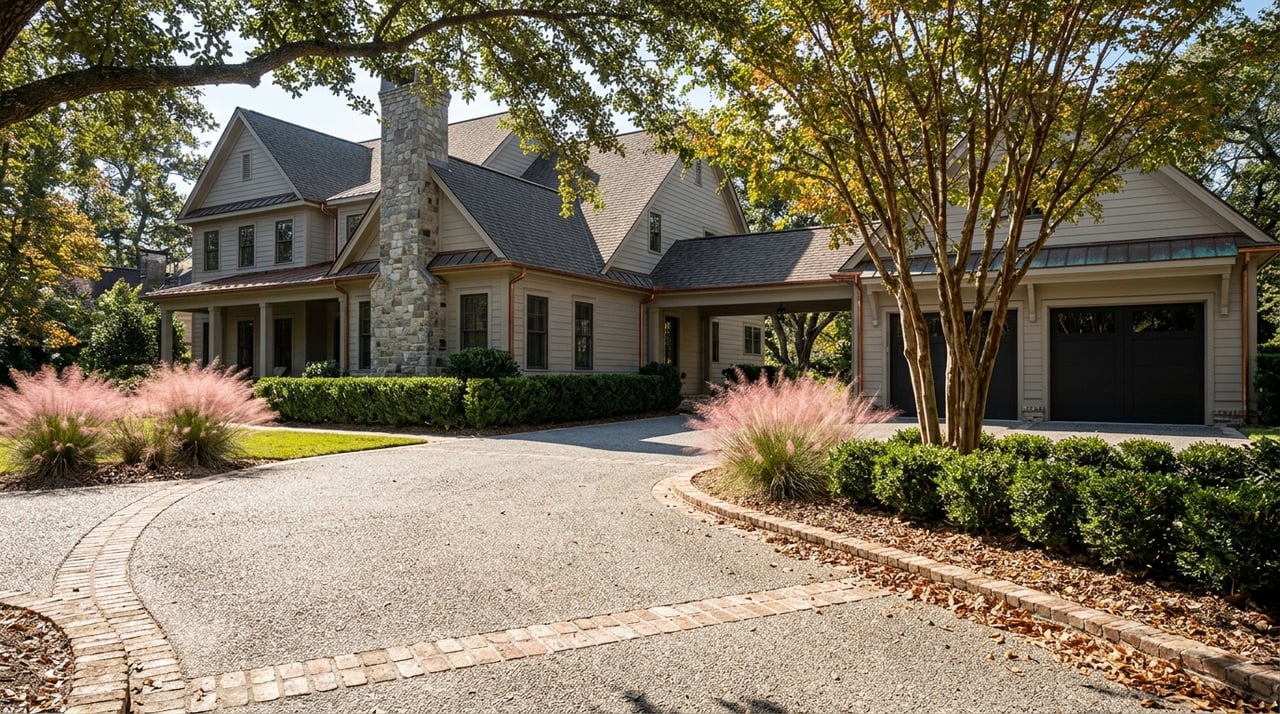
Two Southlake estates sit a quarter mile apart. Same architect vocabulary, same limestone-and-brick tier, same Carroll ISD address. One closed clean in twenty-eight days. The other sat in a second option period while a buyer's lender waited on a Tarrant County Public Health sign-off, an aerobic maintenance contract transfer, and a plumber's bid to run a lateral to a sewer main that stopped two lots short of the property line.
The visible difference between the two homes was zero. The invisible one was whether the house was on city sewer or on a private On-Site Sewage Facility, and whether the irrigation lawn was fed by a metered tap or by a private well. In a city where roughly 7,500 addresses are on the municipal collection system, that split still cuts through some of Southlake's most desirable acreage inventory north of SH 114. It is the one question a buyer's tour cannot answer, and it is the one that most reshapes the deal.
The friction lives in the disclosure packet, not the walk-through
Texas does not require a septic inspection at sale. It does require the seller to say what is there. Under Texas Property Code §5.008, a residential seller completes the Seller's Disclosure Notice (TXR 1406). If the property has an OSSF, Texas REALTORS® form TXR-1407, Information About On-Site Sewer Facility, must be attached. Sellers fill it out themselves, not their agent, and it asks for:
- System type: conventional, aerobic treatment unit (ATU), or holding tank
- Approximate age and installer
- Location of the drain field or distribution system
- Whether a maintenance contract is in force, and with whom
- Last pump date, known defects, and planning materials
TXR-1407 is not a warranty and does not replace an inspection. It is a paper trail. Under §5.008 and the Deceptive Trade Practices Act, a seller who knows the aerobic sprayers throw onto a neighbor's fence line and stays silent is buying litigation risk that dwarfs the price of disclosing.
The transfer detail most Southlake sellers miss: under 30 TAC Chapter 285, the OSSF permit transfers automatically to the new owner on legal transfer of the property. That sounds like relief. It is actually a live obligation the buyer inherits at closing, including any open maintenance-contract requirement.
Aerobic vs conventional changes the math immediately
Roughly one in five new homes in Texas is built on an OSSF. In Southlake, the older tanks on estates built before city sewer was extended tend to be conventional anaerobic systems. Newer builds on tighter lots almost always run aerobic treatment units with surface spray disposal, because ATUs produce cleaner effluent and take less drain-field area.
The cost gap is real. Regional installer pricing runs $10,000 to $15,000 for conventional replacement and $15,000 to $25,000 for aerobic, with heavy variance if excavation is difficult. Aerobic is where the ongoing obligation bites: TCEQ requires a two-year maintenance contract with a licensed provider at installation, and most owners keep the contract for life because ATUs require three professional inspections per year. Expect $150 to $600 annually for that contract in Tarrant County.
If the TXR-1407 says "aerobic," you are not just buying a house. You are buying a service subscription that has to be current on the day the appraiser walks the drain field.
FHA and VA appraisers do walk the drain field. Both loan programs require the system to meet local health code, and appraisers are trained to flag wet spots, odor, and evidence of backups. A failing OSSF discovered by an FHA appraiser is a repair the seller has to make before closing, not a credit the buyer can pocket. Conventional lenders generally follow when the appraiser writes a condition.
Southlake has its own conversion program, and the sequence matters
The city runs a four-step process for owners who want to leave septic behind. The steps are ordered for a reason: skip one and the closing slips.
- Confirm availability. Public Works Operations at 817-748-8082 does a site visit to verify whether sanitary sewer is actually available at your address. Not every north-side street has a main in front of it. Where none exists, Southlake requires a written request routed to the City Engineer at 1400 Main Street, Suite 320, and a petition signed by the majority of affected property owners committing to connect and pay fees before the project is considered for the ongoing Capital Improvements Program.
- Contract with a licensed plumber and pay city fees. The tap fee is waived if there is no existing tap at the property. If a tap already exists, the fee applies. Coordination goes through the Wastewater Division at 817-748-8606, which completes the Field Verification or Septic to Sewer form.
- Abandon the existing septic system. Not simply cap. Abandonment means the tank is pumped, the lid destroyed, and the tank filled with compacted earth, gravel, or sand.
- Coordinate with Tarrant County Public Health. The county documents the abandonment. Without that sign-off, the file is not closed for future buyers or their lenders.
Two frictions specific to Southlake are worth pricing into an offer. First, the city explicitly does not allow sewer service lines to cross adjacent property lines. If the nearest main is on the far side of a neighbor's estate, the answer is not an easement handshake. It is either a petition for a Neighborhood Sewer Program or, more often, staying on septic. Second, the Sanitary Sewer Connection Incentive Program is worth asking about at step one, because it changes the net cost picture before a plumber writes a bid.
The private well overlay
Southlake estates advertise "private irrigation well" on the MLS for a reason. A shallow well feeding sprinklers and hose bibs, at 60 to 220 feet, sidesteps the largest single line item on many Southlake water bills during summer. Local drillers like FlowCore Water, TurnKey Wells, and Priceless Water Wells install and service these across the city. Deep potable wells at 500 feet and up are rarer but exist on the acreage tracts.
For a buyer, three things matter:
- Private wells in Texas are not routinely tested. The owner is responsible. Baseline bacteria and general chemistry testing before closing is prudent, and lenders sometimes require it.
- A well feeding potable water triggers a fifty-foot setback from any septic component. On smaller Southlake lots the interaction between well location and drain-field placement can constrain future renovations, pool builds, and casita additions.
- Well pumps are a wear item. Bladder replacements and pressure-switch failures are common, and neither shows up on a standard home inspection unless the buyer asks the general inspector to sub in a well specialist.
What buyers and sellers should actually price in
| Scenario | What the buyer inherits | Realistic cost band | Deal-timing impact |
|---|---|---|---|
| On city sewer, no OSSF, no well | Standard TXR 1406 only | No systems-related capex | None |
| On aerobic OSSF, contract current | TXR-1407, ATU maintenance contract, three inspections/year | $150 to $600/year ongoing; $15K to $25K to replace | Adds 3 to 7 days to option period for evaluation |
| On conventional OSSF, aging | TXR-1407, pump every 3 to 5 years | $300 to $500 pump; $10K to $15K to replace | FHA/VA appraiser scrutiny; possible pre-close repair order |
| Convert to city sewer at sale | Southlake 4-step; TCPH abandonment | Plumber lateral, tap fee if applicable, abandonment; often $10K to $25K depending on distance to main | 3 to 8 weeks realistic; not compatible with a fast close |
| Private irrigation well only | Well disclosure, pump service | Pump repair $500 to $2,500; baseline testing $150 to $400 | Modest, but extend option period 3 to 5 days |
The reason a fourteen-day option period has become standard practice on Southlake OSSF properties, versus the seven-day norm in the master-planned interior, is on this table. A septic evaluation, a pump, and a well water panel cannot be scheduled, run, and reported in seven business days if the inspector's calendar is tight.
The offer-writing move most buyers miss
For a Southlake home on septic with sewer availability at the street, the strongest offer often prices the conversion into the negotiation rather than the closing. Ask the seller for a credit at closing equal to a documented plumber bid for the lateral plus the anticipated abandonment cost, and confirm in writing whether the tap fee is waived because no existing tap is present. That approach keeps the closing calendar clean, hands the buyer a system with a known end state, and gives the seller a defined dollar exit rather than an open-ended repair demand two weeks before funding.
For a Southlake seller listing an acreage estate on aerobic, the pre-listing move is the inverse. Pull the last three maintenance reports, order a pump, get a current TCEQ-licensed inspector's letter, and attach it all to TXR-1407 in the listing packet. Every one of those documents shortens the buyer's option period and takes a category of price re-trade off the table before it starts.
FAQ
Does Southlake require me to connect to sewer if it becomes available on my street? Not automatically. The city runs a voluntary program with an incentive component. Connection becomes a live requirement when a Neighborhood Sewer Program is approved after a majority-owner petition, or when an existing OSSF fails and cannot be repaired in place under Tarrant County Public Health rules.
If the seller's aerobic maintenance contract lapses, can we still close? Usually yes on a conventional loan if the system tests functional, but the buyer inherits the obligation to reinstate a contract with a licensed provider. On FHA and VA loans, an appraiser flag on visible malfunction becomes a pre-close repair. Reinstating the contract before the appraisal, not after, is the cleaner path.
Is the OSSF permit part of what transfers at closing? Yes. Under 30 TAC Chapter 285, the OSSF permit transfers automatically to the new owner on legal transfer. Ask for a copy of the original permit and any repair authorizations from Tarrant County Public Health during the option period, not after.
Every Southlake estate deal has a version of this conversation buried in the disclosure packet. The clients who close cleanly are the ones whose agent read the TXR-1407 before the offer, not after the inspection. If you are getting ready to buy or list on a septic or well property in Southlake, Move 2 DFW is happy to walk the paperwork with you before the option clock starts. Book a Consultation and we will map the specific systems, program eligibility, and timeline your address actually sits on.